Join the discussions about products powered by Cognite Data Fusion. Click the + CREATE TOPIC button in the menu bar to start the conversation.
Recently active
In bootcamp documentation there were some guiding principles:https://docs-bootcamp.app.cogniteapp.com/content/chapter_0/#the-ice-cream-factory-dataOne of them was for Cognite functions:Cognite Functions for running and scheduling simple and short workloads in Python (< 10 min. execution time)Can we use Cognite functions for long running and scheduling workloads typically of duration 10-12 hours.
Do we have option available to deploy CDF on private cloud.
ContextThis write up describes a basic set up of writing data points to Cognite Data Fusion using Apache NiFi. The source data is power consumption readings from the HAN interface of a power meter in a residential fuse box:The starting point here is an existing MQTT broker that receives data from an existing MQTT client device. We will use Apache NiFi to consume the MQTT messages, extract the readings and write continuously to CDF.The end goal is a live updated time series within CDF with power readings every 2.5 seconds that can be used for analysis or automation within CDF or simply visualization: NiFi flow overviewThe picture above shows the complete NiFi flow. From left to right, consuming MQTT messages, transforming and writing to Cognite Data Fusion. Approximately 120 data points per five minutes, which corresponds to the power meter outputting one reading every 2.5 second. The NiFi flow makes use of the following Processors: Processor Purpose ConsumeMQTT
@Eric Stein-Beldring - is there a way to lock the y-axis when you have a chart in stacked mode? We have a good example that our team has been using where we’ve created a calculated column that we need to zoom in on to see the short term trends, but the moment we move the mouse over the chart the y-axis automatically re-adjusts not allowing us to use the stacked feature. If we could toggle y-axis auto adjustment, that would be very valuable!Not zoomed burgundy line vsZoomed burgundy line
Would like to know in detail about the fact extraction from drilling reports. Is there any capability in CDF to do such fact extraction and relevant methods to process drilling reports?
We are interested in retrieving data from cdf through the odata service. We would do this not from Power BI, but from another Power Platform component, namely Dataverse. (the purpose would be to create "virtual tables" there which we could query, and in that way we could control access to the data more granularly then we are able to thorough the Cognite API) The documentation we find only mentions the OData connector in relation to Power BI (e.g. Cognite Power BI connector | Cognite documentation (cogniteapp.com) and Tips and best practices | Cognite Documentation). Is Cognite's OData service specifically tailored for Power BI, or is it a full implementation according to the OData standard? Is anyone able to recommend for or against attempting the proposed approach?In case the service implements the standard, does anyone know which version of the standard is it?
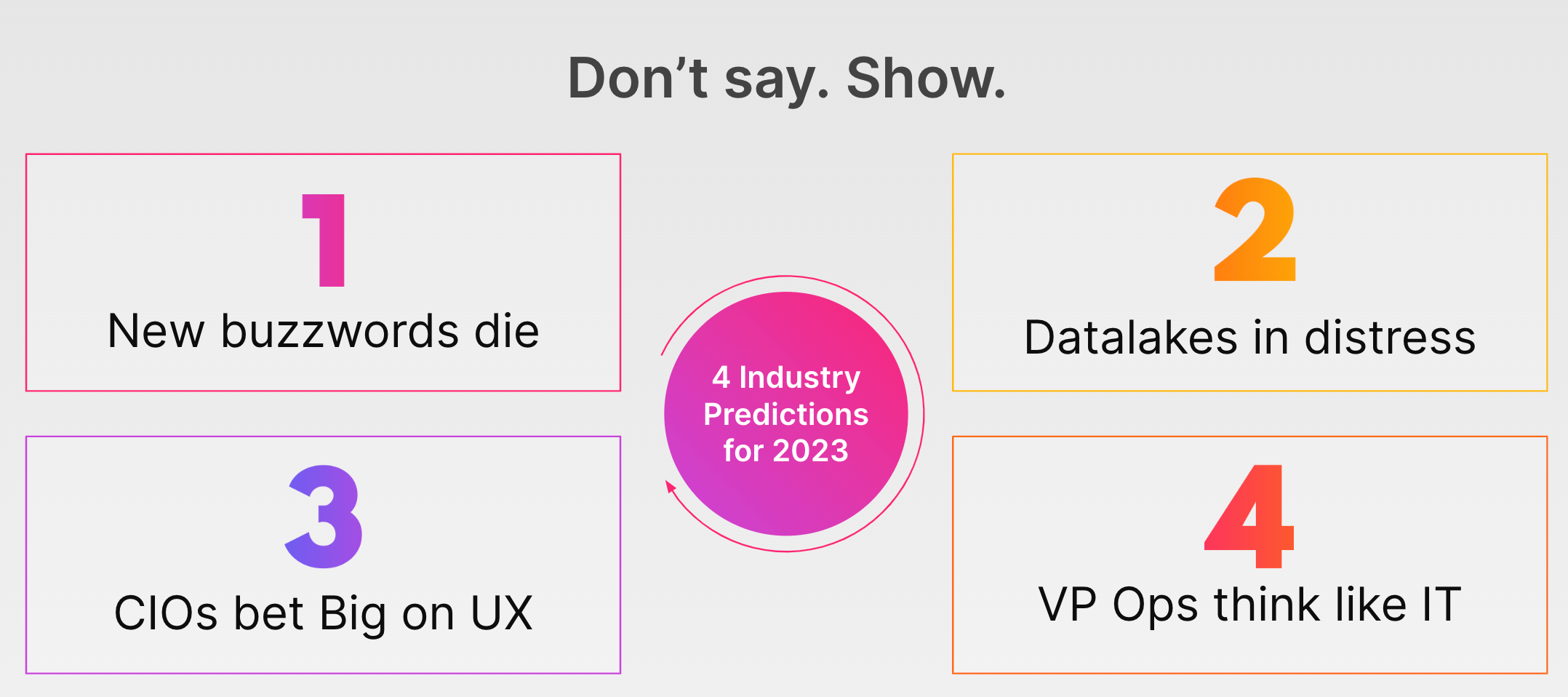
Don’t say. Show.If there ever was one crisp line to capture the essence of what’s in store in 2023 for both buyers and sellers of Industry 4.0 solutions, it could well be this.Staying true to our New Year Predictions format, two disclaimers hold: For those looking for more general technology predictions, there is no shortage of well-researched examples published around this time of the year by the likes of Gartner, Forrester, and Verdantix — we encourage you to seek these out directly; and We are equally not venturing into the macro market factors, as these alike are abundantly covered by financial and even popular media. Instead, let us offer you 4 predictions that are focused on digital transformation of heavy asset industries. As always, let us know what you think by dropping us a line below. New buzzwords die before taking offThis is sobering to see! The last thing needed is one more nonsense buzzword to fill conference stages and drive keyword bidding in vendor SEM programs.We’
I have ingested RAW data into CDF for a bunch of equipment (16) and also applied transformations on those to setup Assets, Timeseries, Datapoints and Events. I have a P&ID diagram (PDF) which has 4 Equipments shown in the Diagram with P&ID#. I would like to know the process of ingesting this file as a resource type for this equipment setup and where do I upload the file? When the user selects any of the above Equipment in CDF, the system should display the enclosed P&ID diagram.
While trying to setup the Google - colab for CDF environment and authentication, i am getting an error. Unable to trace the rootcause of this error. This code is a part of Notebook setup given in the Hands-On course Link to notebook - Data processing and analysis for IDA course.ipynb - Colaboratory (google.com) TypeError Traceback (most recent call last)Cell In [2], line 57 55 def get_token(): 56 return authenticate_device_code(app)['access_token']---> 57 client = CogniteClient( 58 ## token_url=f'{AUTHORITY_URI}/v2.0', 59 token=get_token, 60 token_client_id=CLIENT_ID, 61 project=COGNITE_PROJECT, 62 base_url=f'https://{CDF_CLUSTER}.cognitedata.com', 63 client_name='cognite-python-dev', 64 ) 65 print(client.iam.token.inspect())TypeError: __init__() got an unexpected keyword argument 'token'
@Kristoffer Knudsen In Cognite Infield, It appears that once the checklists are archived, there is a default time period of 3 weeks before they are permanently deleted based on what we see after archiving a checklist (release notes from Jan 2022 seem to show 4 week keep period). Some operating units have longer or shorter retention policy for their checklists, after archival and it would help to have this retention time period configurable. Based on a quick scan of current Infield configuration parameters, it didn’t appear to be a configurable parameter for now, under the Infield configuration items in CDF. Need clarification on this.
Is there any way to read CSV files in an incremental manner from a drop folder following a file name pattern and ingest the data into specific RAW tables.Eg. I have file names which have timeseries data from daily report with columns like asset id, timestamp, data point. With file name pattern as “timeseries_<unique number/date>.csv”. Users are pasting these files in a public sharepoint location in an incremental manner.
As 2022 comes to a close, we thought we’d take a moment to reflect on all the improvements that have been put into InField this year. From small bug fixes to big feature releases, from requests from Hub to user research sessions in person, many of you have contributed to make InField the best it can be for all its users. Throughout the year, InField has been updated with a total of 30 updates packed with user-centered functionality and improvements – and at the same time, the InField team is rebuilding the foundational backend, which sets us up for 2023 and beyond. Users can expect to see major improvements to performance, much improved 3D- and file-viewing, better scheduling of checklists and more capable templates. While we’re working on that, here are some of the improvement and additions the team has made in 2022: January: The Weekly Summary page was introduced We updated the progress indicator to a new status bar, and made it available on mobile Much improved formatting on de
I am currently working on a concept for representing tag data in a simple graph (subject - predicate - object - style)An instance of the triple could be something like this D-20VA00001 - hasDryWeight - 5000In parallell I have instanciated another graph holding ontology data and mapping (like CFIHOS, mapping between CFIHOS class and function code and sap referance data etc.) Lets call it the meta-graph.What I want to do is to take a “traditional” tag as input, map the function code on the tag to corresponding CFIHOS-class, and get required attributes in return from the meta-graph. Further I then want to dynamically instanciate every attribute as relation in the triple’ish graph. In order to do this I need to be able to query a data model (FDM) in a transformation- is that far away?Further, now I am faking a labeled property graph in FDM - is LPG functionality far away?
When creating a transform into an FDM type, it is necessary to provide the externalId of the instance. Does the value of externalId need to be unique across all instances of all types in the model or only across instances of the given type?
Hi I attempt twice and got 73% but not able to attend Assessment one more time. kindly enable so that I will attend assessment. Rajesh
While setting up credentials while transforming getting this error.Error : Session Create Error:Request failed: Status code 401 Tried creating multiple times no luck any help pls
Hi from HUB Ocean and the Ocean Data Platform. We are participating in the open ocean data cataloging scene, for instance through the EU ILIAD “Digital twin of the ocean” project.Home | Iliad - Digital Twin of the Ocean (ocean-twin.eu)In order to improve the interoperability between the myriad of ocean data portals, web services and data catalogues out there, it will be very important for the Ocean Data Platform data catalog to support technologies and concepts like RDF (Resource Description Framework), SHACL (Shapes Constraint Language) and SPARQL (RDF query language). Is this already supported by FDM or is it on the roadmap?
As we develop richer models supporting a greater variety of workflows, we have started asking questions about model maintenance and modularization. Decomposing large models into sub-models that have low coupling seems attractive, but would require some type of referential support across models. Is Cognite considering such a feature, or how do we envision managing complex models in general? As you are probably aware large models have an increased risk that a breaking change in a peripheral type will force a new version on the entire model. Since data must be manually migrated today, this creates a maintenance load that we would be keen to address.
Hello All,I have created dataset, it is available at data set section and but when it comes to contextualize=> “Match entities”=> “Quick match”. and then tried to find my data set with resource type “time series” At this point, i am not able to find the data set, which is already there in the section “manage dataset catalog”. Any specific reason for this?
I used to see a link to Jupyter Notebook on CDF Main Page. Now I dont, what happened?
Below we have outlined several frequently asked questions and their corresponding answers.Don’t see the answer to your question? Post as a reply in this thread and we’ll be sure to answer and/or add it to the FAQ list below!Protip: Use [cmd+f] or [cntrl+f] to search for keywords related to your question.Be sure to also let us know what else we can help answer here in the comments below! Q: What is the plans with Templates going forward?Please check out the documentation hereor https://pr-1023.docs.preview.cogniteapp.com/dev/guides/data-modeling/get-started#templates-future Q: Will there be new features built on top of Templates?Yes and no. We will not be doing any development of backend features (like new capabilities) into Templates. However, we will actually be building a lot of additional tooling on top of Templates (better UI, visualization layers, code generation, CLI etc.). Stay tuned in this Cognite Hub to see how you can use these tooling.
Team - is there a way to generate a calculation in Cognite charts where you’re comparing data from the current timestamp value to something several minutes prior (say 30 minutes)? Any assistance on this would be welcome!
Cognite Team - thank you for bringing back the ability to overlay events directly on the chart as was previously a capability in ADI. It’s a welcome return and valuable add to the application.After utilizing the app a bit, I have a couple of “low hanging fruit” recommendations:Can we add the event description to the metadata that’s shown on the event? Is there a way to toggle using both start time and end time vs. just using start time? Some of the events that we have run for months and the start time is really the only relevant point for the trendHere are some more complex recommendations:Since charts is now integrated directly in Data Explorer - is there a way to click on the event results and actually go to the event directly in CDF to look at all the metadata? When filtering for events by selecting the asset - is there a way to toggle “select all children” as well? An example is that we have several pumps where work is tagged to the smallest component, but if we filter the events t
Hi,I’m just getting started with Cognite. I’m trying to create some assets. I’ve loaded them into RAW and I’m trying to write a SQL transformation to load them into assets. Is there documentation on what functions are available? I’ve gone through the online training and the simple example there, but it doesn’t cover what I’m trying to do.My specific questions are that I’m looking for documentation to answer are (for now):What data type is the id, parentid, and other fields How do I cast the string data in the csv to right type. I assume there is a Cast function The UI tells me I have the wrong type. It doesn’t tell me which field and what type it expects. That would really be helpful. In this case, I know what field, but I don’t know the type it’s looking for. For a top level asset in the hierarchy, what do I use for parentID? If I have spaces in the field names in my CSV, how can I reference the field?
Asset Data Insight (ADI) looks to be a very promising analysis tool. I realize it is in beta, but I want to share a couple of my impressions from using it over the last couple of days. Perhaps these suggestions can make it to a list of features to be implemented for the coming releases.I am a bit confused about the future development of ADI and Cognite Charts. There is clear overlap in functionality, and yet key features in ADI are not present in Charts, and vice versa. Will one take over for the other? Will they coexist? If one will be deprecated in the future, my feedback still is relevant for the one that survives.#1 Make all Chart functionality available in ADI.The calculation node editor is especially useful, but the interface for customizing how toe visualization looks is better in Charts than in ADI. #2 Improve the Events layerOverlaying events, such as maintenance history, on key time series can be very useful. However, the current implementation is lacking. The filtering of ev


 Check the
documentation
Check the
documentation Ask the
Community
Ask the
Community Take a look
at
Academy
Take a look
at
Academy Cognite
Status
Page
Cognite
Status
Page Contact
Cognite Support
Contact
Cognite Support