Join the conversations to shape a safer, more efficient, and sustainable industrial future!
Recently active
Hello, We are heavely relying on transformations to transform our data from Raw (staging) service to Data Models. We notice that it has very high latency compared to a “simple” Spark job. As per our discussion with our Solution Architect we understood that the bottleneck is the Raw service. Any plans to improve this in the future? Thank you!
Hi, I am on Data Scientist Learn training. I´m getting the 404 Not Found error whenever I try to make a GET request for publicdata project. That´s the URL I´m trying to use{{baseurl}}/api/v1/projects/{{project}}/assets I also replaced {{project}} with ‘publicdata’ with same result.
Hello,I am working with the Cognite Data Modeling API to validate edges in a large data set. Our edges do not have a dedicated "edge view" defined in the model. When I attempt to use the instances.query() API to fetch edges filtered by their type, I encounter errors or unexpected behavior indicating that selected properties do not match the view schema.Specifically, filtering or selecting on properties such as "externalId" fails because the queried view does not explicitly contain those properties, as the edges exist only as instances without a separate view.Is there a recommended approach or best practice for querying and validating edges in scenarios where no dedicated edge view is defined? Should we rely exclusively on the instances.list() API with filters, or is there a way to construct valid queries for edges in the current model setup?Any guidance on how to effectively query and validate edges in such cases, especially for large-scale data, would be appreciated.Thank you!
Hi,I use “Relationship labels” to contextualize related timeseries, events, sequences from other CDF datasets.In the example below you can see the asset called “A-03” which has 157 related timeseries. However, only approx. 30 out 157 labels belong to the asset “A-03”, the rest 127 labels belong to the children (L1, L2, L3 ...). I don’t want the children’s labels to belong to the parent asset (A-03), I want the parrent asset (A-03) only having its own 30 “Relationshop labels”.is it possible to do?
Hi Cognite Team,I'm building a React dashboard using Cognite Data Fusion for my portfolio and would like to know if there are any demo projects available for working with CDF data.
Working with file extractor for sharepoint files givers you and option to set recursive mode on/off which does not recurse over subfolders (when set to false) according to your needs.But when i set that option for simple files, it does not works, also the documentation does not mention the keyword recurvisive for files.It wpuld be great the file extractor also has the recursive keyword so you dont need to have specific filders for files to upload. thank you sw
When adding a file to an existing canvas from search, the file can not be resized in canvas, but when added via "add data" button is allows resize without issue.
We’re using the client.documents.previews.download_page_as_png_bytes() function in the Python SDK to retrieve png previews of P&IDs in order to display them in a webapp (Streamlit).For some P&IDs, the dimensions of the returned png are distorted. The image is in the correct orientation but squashed to fit within a portrait envelope. The affected P&IDs are displayed correctly in both CDF Data Management and when downloaded and opened in a pdf viewer.Has anyone had this issue before and, if so, did you find a way to handle it?
Resizable preview panel is released!A repeated request has been to allow for adjusting the width of the side panel in Search.As of today, you can adjust the side panel width to preview data more easily without leaving search or browse mode. Hope you like it!Best, Sofie
Hi Cognite team,I understand that Atlas AI is not available in the PublicData project and is primarily for enterprise tenants.I’d like to explore whether there is any possibility of getting sandbox access, a developer trial, or demo environment where I can experiment with Atlas AI using example data.Could you please let me know if there are options for developers or small teams to try Atlas AI in a non-enterprise context?Thanks a lot!
Hi Everyone,I'm part of the performance team, and I want to learn more about transformation.My main goals are:To understand the basic way it works. To see how each step interacts with different parts, so I can troubleshoot problems better. To find out what kinds of scenarios are commonly used with customers. To know which metrics we are currently monitoring in Grafana to check for issues like server errors (5xx), high CPU usage, or memory problems. To learn where I can see live logs. To understand which customer is the biggest right now and what’s the largest amount of data used for transformation so far.
Something is wrong with this overview. The fields CREATED/STARTED/FINISHED does not seem to correspond with what is shown in the graph, and the DURATION.Can someone explain what the STARTED field actually is, the graph and the timestamps don’t line up. Does it count the start of the transformation when it start writing or when it start reading (only one of these is sensible).The duration should be the time between the transformation was triggered and it was completed. From the perspective of the user the transformation has started when it triggers, how long it takes before it actually begins should be part of this duration. Measuring both intervals could be interesting, but the one that is currently there is not really useful for us.
The external id of some time series contains special characters. Should they contain special characters, no, but that is not the issue here. As long as CDF allows special characters in their ID’s it should also have support for them in the rest of the system. When you press the copy button in Fusion you don’t get the special characters, and without those characters the ID is invalid and cannot be used. Hence the copy button does not actually copy the external ID, it alters it and that is an issue.# The actual external IDLIMS_Skarv_Analysis 9-ion analysis_SP 44-AP-0027 - DS - 2. STG\xa0SEP_Param Sulphate, SO42-_Unit mg/l# Copied from Fusion UILIMS_Skarv_Analysis 9-ion analysis_SP 44-AP-0027 - DS - 2. STG SEP_Param Sulphate, SO42-_Unit mg/lThe fact that the external ids contain these characters to begin with is a different issue we are looking into.
Hi,First of all, where can we get the OID Project public data API documentation, and what are the parameters we need to pass to fetch the data?My aim is to use OID public data to access any asset — for example, a pump set — and display its data and health status on a dashboard. The dashboard will be built using React, and for the backend we can use FastAPI with the Cognite SDK.
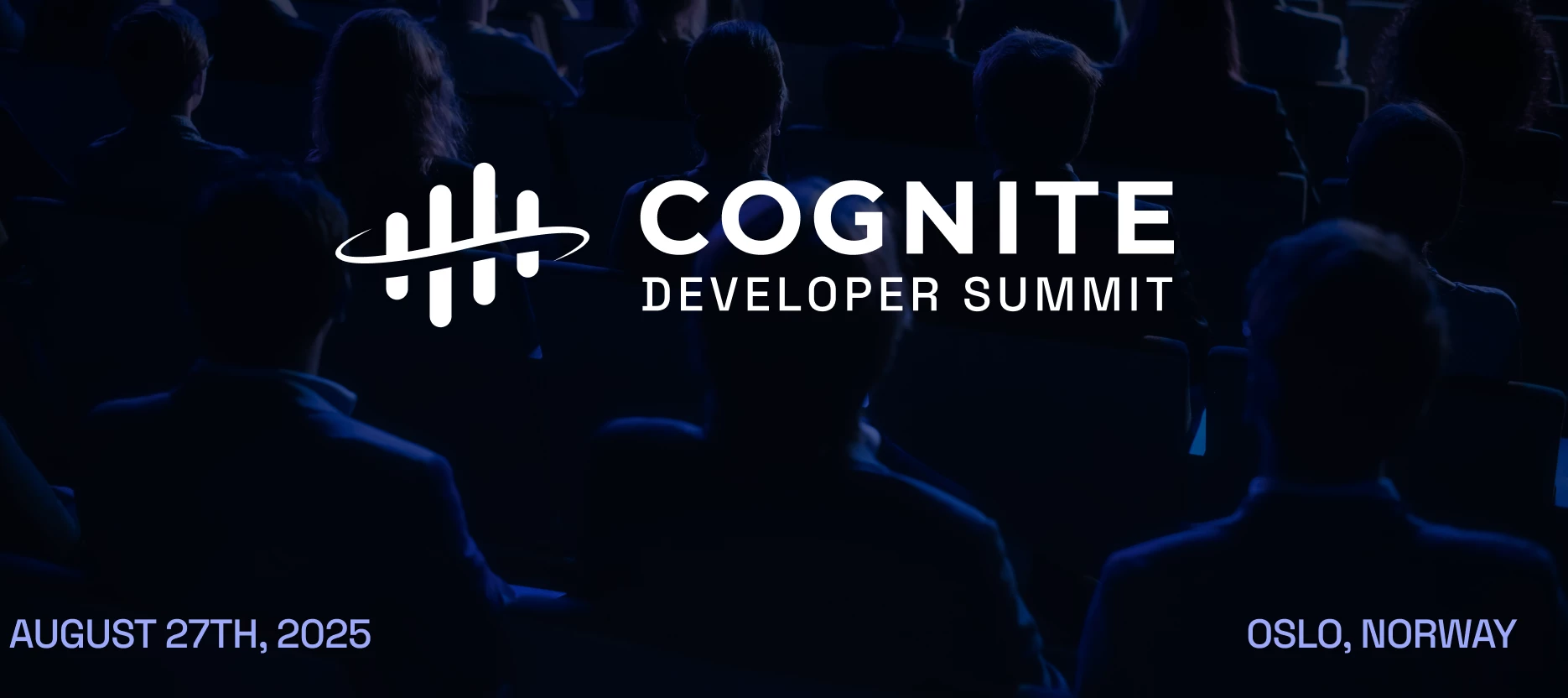
We are excited to announce the Cognite Developer Summit, which will take place this month (27 August) in Oslo. This is an exclusive in-person opportunity to explore what's possible with Cognite Data Fusion. Read on for the details and for a chance to interact with the speakers even if you can't make it.The day features sessions from technical experts, including software engineers from innovative companies like Properate, technical partners like AWS, and developers at Cognite. Come hear from those who've done their share of building, talk about your experiences and challenges, and meet others who've gone through similar journeys.Register here! As our Hub member, you can sign up for free using the promo code COGSHUBS.Event detailsDate: August 27, 2025 Time: 08.00-17.00 Location: Grand Hall, Oksenøyveien 10, 1366, Akershus, Norwayp.s. If you can’t make it, review the agenda and ask speakers questions about their topics in the comments. We’ll try our best to get you some answers. Some of
HiWe are testing out a new deletion transformation for a view in data modeling. The transformation looks something like this:select externalIdfrom cdf_data_models(...)where project in ("ProjectA","ProjectB")This transformation always times out and returns a “Graph query time out” error message. However, when changing the transformation to this the transformation just runs fine:select externalIdfrom cdf_data_models(...)where project = "ProjectA"unionselect externalIdfrom cdf_data_models(...)where project = "ProjectB"For context, the project column here is indexed and the view has around 10 properties and about 1.7 million rows. The transformations all query the same view.We are therefore wondering how the filtering in transformations handles filtering in data modeling and why these transformations are performing different. Learning more about this would benefit us greatly when working with transformations and data modeling in the future :)Thanks in advance!Sebastian
Hi there!A quick update from our team;By popular demand, we have now introduced a “select all” option in your filters, as well as support for filtering on Enum properties! 💃🏻Note: We do have a 1000 instance limit in the API when working with filters. Best, Sofie, Product Manager
Hi When testing some new functionality in a Cognite Function I got this error message: “The size of the data field is too large.”The data input was from the output of another function ran previously in a workflow.I am looking through the documentation to find what the limits are, but can not find anything.For my use case I can decrease the input size and run more batches, but it would be good to know what the size limits are for input data into Cognite Functions. Also, are there any other size limits I should be aware of?Thank you!Sebastian
All,Now that you’ve had some time to “play with” the Records feature, we’re looking to identify what the consensus is when it comes to the available aggregations for Records. Do we have a useful mix of aggregations available in the API today? Which of the aggregates do you use most often? What is your experience with the API documentation for aggregate API endpoint so far? Have you attempted to use the movingFunction aggregate? What problem did you use it to solve for your use case? Was the information in the documentation sufficient and useful for you? If you haven’t used the aggregate, please help us understand why not? Have you attempted to use the timeHistogram aggregate? Was the information in the documentation sufficient and useful for you? If you haven’t used the aggregate, please help us understand why not? Is there a use case involving aggregates that you have not been able to address in Records? Please describe the use case? How important is the “missing” aggregate for
Had a chance to experiment with streams and records and it seems to be working well. Couple of questions based on what I found:Are any of the filtering options that are available for general data modeling queries but not available with records likely to be supported in future? Specifically, I am thinking of queries like Fetch me all of the records in the last week where the `asset` property is below `Facility-ABC` (i.e. it contains `Facility-ABC` in asset.path). I think this would require us to use the nested filter unless the total number of assets that were below Facility-ABC was small enough to pass them directly into the filter. I can imagine that this kind of filter is more difficult to implement and a more expensive operation, but I think it could be valuable. Is there a reason why containers rather than views must be used when creating/querying records? It seems like a view with a specific version is nothing more than a set of containers with a (possibly incomplete) list of
All,We’re readying a release of the OPC UA Extractor with support for the Records API and are looking for help with testing data flow of OPC UA events/alarms to CDF Records. The extractor creates containers for several different OPC UA event types and will be able to store data in either mutable or immutable streams (as specified in the configuration file for the extractor)Please reach out - feel free to email me at thomas.sjolshagen@cognite.com and let me know if you’re interested in testing the new extractor).Also, keep in mind that we have support for Records as a target and source in the Hosted extractors for CDF, so let me know here if you’ve got questions about how to use the hosted extractor for the purpose of onboarding relevant data to Records.
“I’m using cognite/opcua-extractor-net as container.Is there a docker image version for linux/arm64 platform available ? (not present on docker hub)”
hi guys, can you please tell me the reason of the error below while API testing in Postman:any help is very much appreciated
Hello,I am using OPC UA extractor to bring in sensor data in my cdf project. I want to limit the number of tags I am bring in from the source. I observed that in the PI extractor there is capability to include or exclude tags. Is there a similar filtering capability in OPC UA Extractor?
Hello,I am testing streams and records in one of our projects, but I am getting “The user does not have any ILA streams capabilities.” error.I am also not able to add the capabilities for Streams and Records to my user group as I cannot see them in the capability type list


 Check the
documentation
Check the
documentation Ask the
Community
Ask the
Community Take a look
at
Academy
Take a look
at
Academy Cognite
Status
Page
Cognite
Status
Page Contact
Cognite Support
Contact
Cognite Support