Join the discussions about products powered by Cognite Data Fusion. Click the + CREATE TOPIC button in the menu bar to start the conversation.
Recently active
Hi community members, Many of you have likely heard of – or directly experienced – the industrial data problem that stands in the way of the success of Asset Performance Management (APM) strategies and solutions.In light of this, we wanted to share an insightful report recently published by Verdantix that highlights these challenges and compares APM vendors on the market today.We’ve summarized the key findings from this report as a guide for asset-heavy organizations seeking to invest in Asset Performance Management software. Click here to read more on our blog.We genuinely value your input and would love to hear whether these challenges and proposed solutions resonate with you too? Your thoughts and experiences are important to us as we continue to explore ways to overcome the hurdles faced by the industry. Thank you for being a part of our community, and we look forward to your valuable thoughts!
“So, what actually is contextualization?” As a Cogniter, this has to be the question we get asked most frequently. From customers, partners, and peers, as well as family and friends.If you’ve asked yourself this question, then I’d highly recommend reading this blog post where @terjelo offers a great (and simple!) definition, as well as a real-world industrial example. Hopefully it’s something you’re able to use when your colleagues ask you more about contextualization! contextualization (noun)Contextualization is the process of identifying and representing relationships between data to mirror the relationships that exist between data elements in the physical world. The result is a richer data model that is greater than the sum of its source systems.
Have a feature request or idea for a new and improved functionality?Then we want to hear all about it! We’re constantly working to improve the Charts product experience.You can choose to either create a dedicated post (topic) in the Charts group by clicking the Create topic button OR simply post a reply below in this thread. Remember to say whether your feature request is Nice to have, Important, or Critical to you and why. Screenshots, sketches, or explanatory videos are also encouraged.
With our focus on real-world operational value, delivered at the core of mission-critical digital transformation programs, we are proud to announce being the first and only software platform in the world to achieve compliance with DNV-RP-A204, the energy industry’s recommended practice on how to build and quality-assure digital twins. This certificate of cutting-edge industry standard compliance is further a validation that Cognite Data Fusion delivers best-in-class Open Industrial Digital Twins that:Accelerate and scale AI Asset Performance Management solutions with cross data-source insights Connect to physics simulators and deploy physics-guided machine learnings Establish confidence in the data and computational models running the digital twin Enable predictive analytics solutions like scenario planning Deliver intuitive data visualizations that drive agility and valueYou can read more on: Cognite Data Fusion achieves industry-first DNV compliance for digital twins.If you have ques
Why are algorithms and data-driven models only available for the few domain experts who also are fluent in advanced software coding? We certainly don’t believe this should be the case.We are making them available to the rest of the world — particularly to non-coding domain experts.For many years industrial data scientists have been building smart algorithms to solve complex industrial problems. They are now available in a no-code drag-and-drop intuitive interface. Liberate your data and empower domain experts the tools to drive impact every day.Cognite Charts includes several data science toolboxes that provide subject matter experts (SMEs) out-of-the-box algorithms to process and manipulate data, conduct root cause analysis (RCA) and develop solutions without having to code.The toolboxes cover basic operations, statistical methods, data transformation, and advanced models. They work out-of-the-box with Cognite Charts, and we will continuously add new algorithms, features, and functi
Hi Digitalization Community!As we grow we're constantly looking to improve our community, and one of the changes you might notice is your new level badge. You can read more about it below 🏅
Cognite Asset Performance Management addresses common business problems faced in the asset-heavy industry, such as aging assets and workforce, increasing maintenance costs, and unplanned downtime. A challenge to close the improvement loopSolving the current business problems spans three main business processes; reliability, maintenance, and operations, forming an industrial improvement loop. However, it’s challenging to close this improvement loop due to siloed architectures, siloed tools, and manually orchestrated processes where often excel and paper-based knowledge gets stuck. Cognite aims to systematically bring these industrial processes together to create a dynamic and optimized asset performance management process that keeps improving. Unlock your tribal knowledge to complete the APM data catalogueCognite Data Fusion (CDF) ties together unstructured and structured data to make a complete APM data catalog. However, CDF can only do this in conjunction with applications anchored
Hi fellow Community Members! Here’s a quick update on our joint community achievements in a little over a year: 3200 Community Members 2800 Posts 2000 Questions Answered 250 Product Ideas 1100 Badges AwardedTHANK YOU for making our community a special and inspiring place to make data do more for our industries.As we grow we're constantly looking to improve our community, and one of the changes you might notice is your new level badge. You can read more about your new level badge below. We hope you like it, you’ve earned it! 🏅
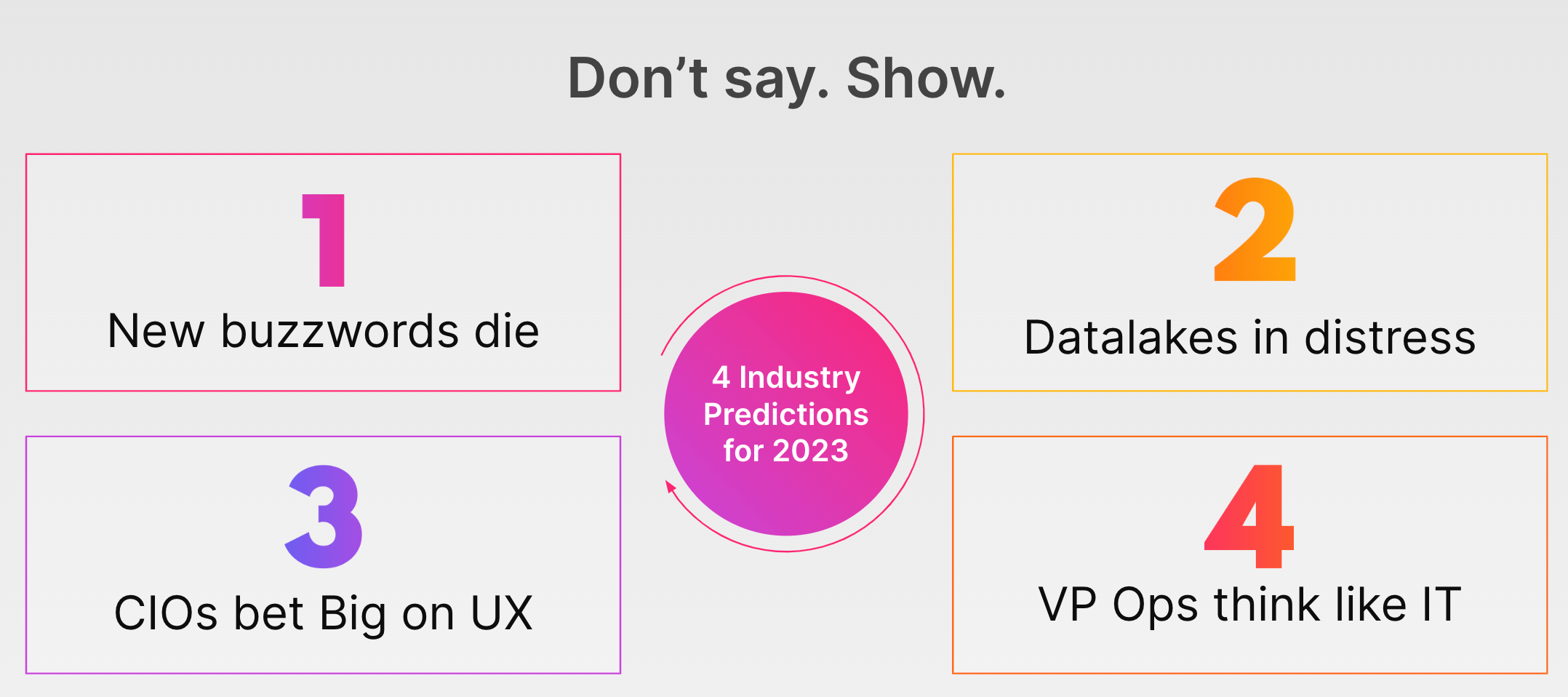
Don’t say. Show.If there ever was one crisp line to capture the essence of what’s in store in 2023 for both buyers and sellers of Industry 4.0 solutions, it could well be this.Staying true to our New Year Predictions format, two disclaimers hold: For those looking for more general technology predictions, there is no shortage of well-researched examples published around this time of the year by the likes of Gartner, Forrester, and Verdantix — we encourage you to seek these out directly; and We are equally not venturing into the macro market factors, as these alike are abundantly covered by financial and even popular media. Instead, let us offer you 4 predictions that are focused on digital transformation of heavy asset industries. As always, let us know what you think by dropping us a line below. New buzzwords die before taking offThis is sobering to see! The last thing needed is one more nonsense buzzword to fill conference stages and drive keyword bidding in vendor SEM programs.We’
If you are curious on how to get the most out of your Cognite Data Fusion subscription, you have come to the right place. This is part of a series of posts where we share some of our experience from working with customers in their journey towards an Industrial DataOps organization. We want to share lessons learned, mistakes made, good practices observed, and observations of pitfalls and risks. This is not the absolute truth, but hopefully a way to spark good discussions around an inherently complex topic!To quickly introduce ourselves, we are @Arjo Oosten, Digital Transformation Leader, winter sport addict and passionate about driving hands-on digital growth strategies and value based decision making, and @Karolina Luna, Solution Architect, cat lover, and passionate about the lifecycle perspective of everything (like solutions and data products).To learn more about Cognite Data Fusion, we recommend this post. Cognite’s Solution SupportWe have presented some models for organization we h
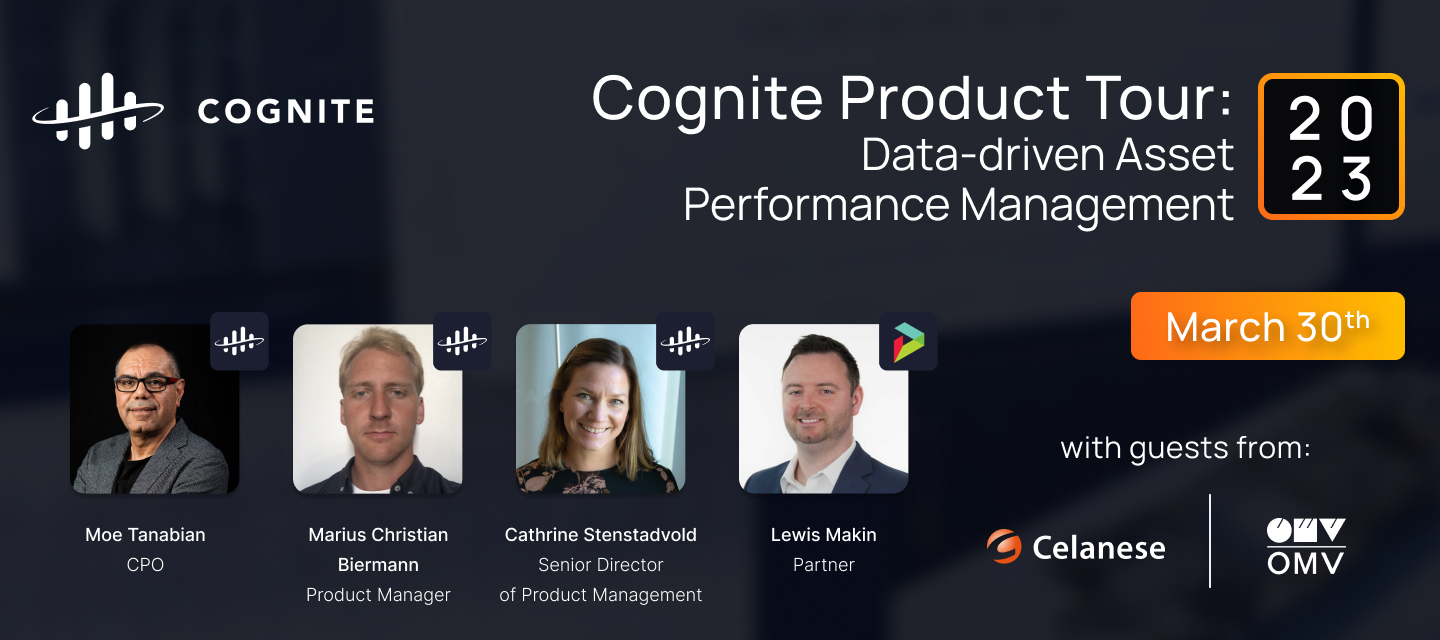
We’d love to hear from you already now with your questions and expectations for the Cognite Live Product Tour 2023 that will take place March 30th! Let us know your thoughts in this thread 🚀 If you haven’t already signed up, you can do so here. Looking forward to hearing from you and hope to see you there!
If you are curious on how to get the most out of your Cognite Data Fusion subscription, you have come to the right place. This is part of a series of posts where we share some of our experience from working with customers in their journey towards an Industrial DataOps organization. We want to share lessons learned, mistakes made, good practices observed, and observations of pitfalls and risks. This is not the absolute truth, but hopefully a way to spark good discussions around an inherently complex topic! To quickly introduce ourselves, we are @Arjo Oosten, Digital Transformation Leader, wintersport addict and passionate about driving hands-on digital growth strategies and value based decision making, and @Karolina Luna, Solution Architect, cat lover, and passionate about the lifecycle perspective of everything (like solutions and data products). To learn more about Cognite Data Fusion, we recommend this post. DevOps and Industrial DataOpsBoth DevOps and DataOps have many different def
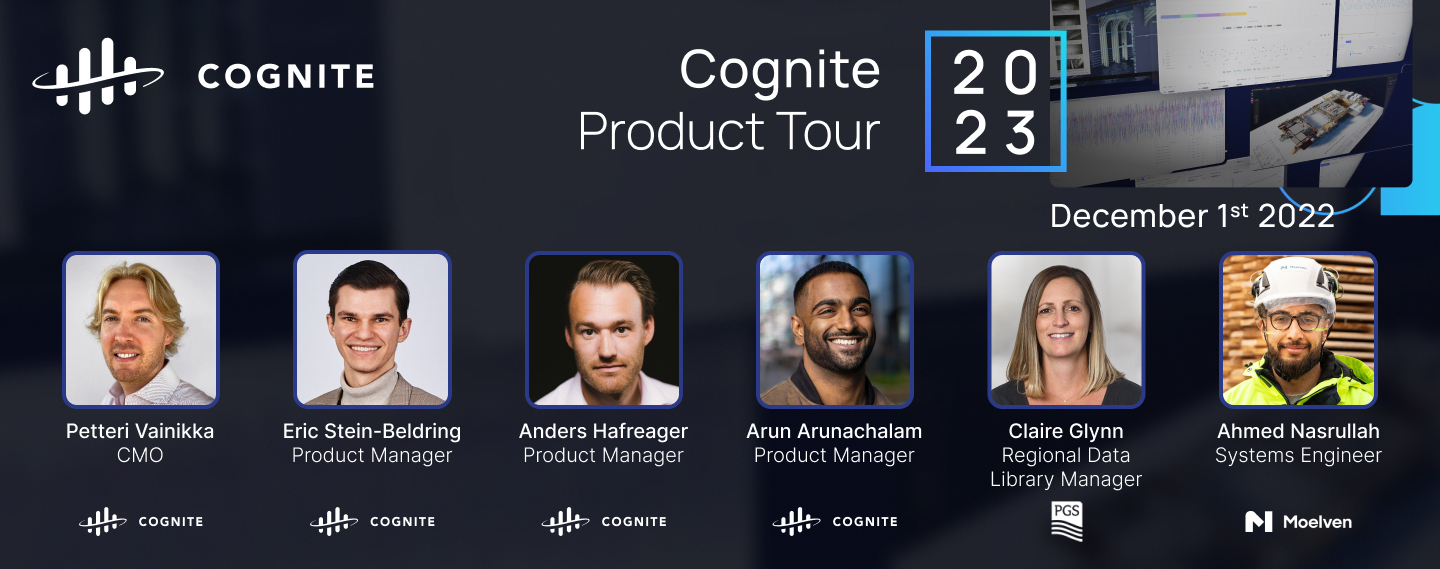
The Cognite Live Product Tour 2023 is just over a week away! This event is our annual showcase of Cognite Data Fusion functionalities – both those that will be released in our upcoming December 6th release, and looking ahead at what is to come throughout the new year. We’ll be driving a discussion with you – our community – about Industrial DataOps and the value of empowering Subject Matter Experts in the industrial organization. We hope you’re looking forward to the event as much as we are! Below is an outline of some of the exciting topics we’ll be discussing. WATCH THE COGNITE LIVE PRODUCT TOUR 2023 RECORDING INDUSTRIAL DATAOPS AND THE SUBJECT MATTER EXPERTIndustrial DataOps is about breaking down silos and optimizing the broad availability and usability of industrial data. Learn about why we are focusing on enabling the Subject Matter Expert throughout 2023 and the two main challenges that SMEs in every industrial sector face. COGNITE DATA FUSION: HIGHLIGHTS OF OUR DECEMBER 2022
If you are curious on how to get the most out of your Cognite Data Fusion subscription, you have come to the right place. This is part of a series of posts where we share some of our experience from working with customers in their journey towards an Industrial DataOps organization. We want to share lessons learned, mistakes made, good practices observed, and observations of pitfalls and risks. This is not the absolute truth, but hopefully a way to spark good discussions around an inherently complex topic!To quickly introduce ourselves, we are @Arjo Oosten, Digital Transformation Leader, winter sport addict and passionate about driving hands-on digital growth strategies and value based decision making, and @Karolina Luna, Solution Architect, cat lover, and passionate about the lifecycle perspective of everything (like solutions and data products). To learn more about Cognite Data Fusion, we recommend this post. Outsourcing FTW?As many companies have found, it can be hard to attract the
If you are curious on how to get the most out of your Cognite Data Fusion subscription, you have come to the right place. This is part of a series of posts where we share some of our experience from working with customers in their journey towards an Industrial DataOps organization. We want to share lessons learned, mistakes made, good practices observed, and observations of pitfalls and risks. This is not the absolute truth, but hopefully a way to spark good discussions around an inherently complex topic!To quickly introduce ourselves, we are @Arjo Oosten , Digital Transformation Leader, wintersport addict and passionate about driving hands-on digital growth strategies and value based decision making, and @Karolina Luna , Solution Architect, cat lover, and passionate about the lifecycle perspective of everything (like solutions and data products). To learn more about Cognite Data Fusion, we recommend this post. Knowing which roles you need for your Industrial DataOps organization, as c
If you are curious on how to get the most out of your Cognite Data Fusion subscription, you have come to the right place. This is part of a series of posts where we share some of our experience from working with customers in their journey towards an Industrial DataOps organization. We want to share lessons learned, mistakes made, good practices observed, and observations of pitfalls and risks. This is not the absolute truth, but hopefully a way to spark good discussions around an inherently complex topic!To quickly introduce ourselves, we are @Arjo Oosten, Digital Transformation Leader, winter sport addict and passionate about driving hands-on digital growth strategies and value based decision making, and @Karolina Luna, Solution Architect, cat lover, and passionate about the lifecycle perspective of everything (like solutions and data products). To learn more about Cognite Data Fusion, we recommend this post. Different types of cross-functionalIndustrial DataOps, like all other Ops mo
“Data has no value unless the business trusts and uses it” There is no shortage of data in any industrial company, but there is a general lack of understanding on how to extract it, bring it together, and use it in an actionable way.There are two discomforting truths within digital transformation across our key industries; energy, utilities, and manufacturing: Digitalization PoCs are commonplace. Real ROI isn’t. Billions are invested in cloud data warehouses and data lakes. Most data ends there, unused by anyone for anything. At the heart of this data-driven value dilemma lies a confluence of challenges, ranging from the technical (How can we best organize our diverse and fluid data universe?) to the operational (How can we create new information products and services?), to the financial (How can we treat data as an asset?), to the human (How can we improve data literacy and ensure digital solution adoption in the field?).With more and more of our industrial operations data readily
Schedule a personalized demo to learn how Cognite Data Fusion™ generates fast, scalable value from your data, enabling better decision making about maintenance, production and safety.In the demo, we will:Understand your priorities, initiatives and challenges that you are looking to solve Introduce Cognite and share examples of use cases we deliver for our customers today Identify areas where Cognite Data Fusion can help your organizationRequest demo with one of our product experts
If you are curious on how to get the most out of your Cognite Data Fusion subscription, you have come to the right place. This is part of a series of posts where we share some of our experience from working with customers in their journey towards an Industrial DataOps organization. We want to share lessons learned, mistakes made, good practices observed, and observations of pitfalls and risks. This is not the absolute truth, but hopefully a way to spark good discussions around an inherently complex topic!To quickly introduce ourselves, we are @Arjo Oosten, Digital Transformation Leader, winter sport addict and passionate about driving hands-on digital growth strategies and value based decision making, and @Karolina Luna, Solution Architect, cat lover, and passionate about the lifecycle perspective of everything (like solutions and data products). To learn more about Cognite Data Fusion, we recommend this post.Planning your solutions and Industrial DataOps with Cognite Data FusionTo be
INTRODUCTION A digital twin can be one of the most useful, insightful tools to drive industrial innovation. While the digital twin concept is no longer new, the capacity of the term continues to expand based on technological advancement, particularly in the realm of the Industrial Internet of Things (IIoT). Over time, digital twins have morphed to meet the practical needs of users. In oil and gas, for example, the possibilities of condition-based monitoring and predictive maintenance have amplified the need for a digital representation of both the past and present condition of an object or system. Gartner predicts that “by 2023, 33% of owner-operators of homogeneous composite assets will create their own digital twins, up from less than 5% in 2018” while “at least 50% of OEMs’ mass-produced industrial and commercial assets will directly integrate supplier product sensor data into their own composite digital twins, up from less than 10% today.” In the same report, Gartner indicates that
Below we have outlined several frequently asked questions and their corresponding answers.Don’t see the answer to your question? Post as a reply in this thread and we’ll be sure to answer and/or add it to the FAQ list below!Protip: Use [cmd+f] or [cntrl+f] to search for keywords related to your question. FAQs How do i use monitoring in CDF and access the documentation?You can access the documentation for the new monitoring solution in CDF here: https://docs.cognite.com/cdf/charts/#monitoring.
Introduction In this post we continue to share some of our internal material aimed towards solution builders, such as data scientists, who want to develop their ability to develop high quality solutions by creating more reliable, maintainable and readable code. This is the second part of 2.MotivationHigh code quality is easy to recognize but can be very hard to describe concretely. The assumed benefits are easier maintainability, modifiability, and more. While code style, like formatting, can be a matter of different taste, most parties agree that other code practices that fall under the umbrella term “anti-patterns” should be avoided. To stop endless formatting discussions and the like, having (and adhering to the industry) standard makes reading and understanding code across repositories easier.What this guide is notThis guide will not tackle the topic of “how to set up a Python project” the right way . Please let us know in the comments if you would like us to share more of our ex
Only a fool believes in different outcomes by doing the same as before.Executive summary: The modern data stack - a more nuanced view of data platforms - is quickly gaining ground, focusing on making data truly useful, not just storing it in the cloud Modern data stack based platforms (simply referred to as 'platforms' from hereon) are the only means of moving beyond costly, monolithic, closed business applications that maintain business and data silos, preventing real digital transformation Platforms themselves are equally no longer monolithic products, but equally composed of interoperable platforms services from multiple open platforms Open platforms with composable business applications are the new technology imperative. Old technology stacks, and “lets only focus on the discrete business solution at hand” approaches don’t work for the 2020s enterprise OT, IT, and business must work together to prevent tug of wars - and instead - collaborate to secure competitiveness in the
Introduction In this post we share some of our internal material aimed towards solution builders, such as data scientists, who want to develop their ability to develop high quality solutions by creating more reliable, maintainable and readable code. This is the first part of 2.MotivationHigh code quality is easy to recognize but can be very hard to describe concretely. The assumed benefits are easier maintainability, modifiability, and more. While code style, like formatting, can be a matter of different taste, most parties agree that other code practices that fall under the umbrella term “anti-patterns” should be avoided. To stop endless formatting discussions and the like, having (and adhering to the industry) standard makes reading and understanding code across repositories easier.What this guide is notThis guide will not tackle the topic of “how to set up a Python project” the right way . Please let us know in the comments if you would like us to share more of our experience in t
I tried logging in with these commands: platypus login --cluster greenfield --tenant "schema-test"which didn’t work as I thought the tenant was a CDF tenant and not an Azure AD tenant. Then I tried:platypus login --cluster greenfield --tenant "c08c2afd-4823-482b-9113-ed2746fe6026"Which gave me a “Login successful” webpage, but the CLI said: “failed to authenticate against CDF project: platypus”. Then Soumesh pointed out that platypus is the default project, and I needed to type: platypus login --cluster greenfield --tenant "c08c2afd-4823-482b-9113-ed2746fe6026" schema-testWhich worked I think having default values made it harder to use as the CLI didn’t guide me on missing project name / CDF cluster etc, and maybe a better name than tenant as it can be interpreted as CDF tenant/project.


 Check the
documentation
Check the
documentation Ask the
Community
Ask the
Community Take a look
at
Academy
Take a look
at
Academy Cognite
Status
Page
Cognite
Status
Page Contact
Cognite Support
Contact
Cognite Support