
Gathering Interest

User‑Configurable Switch for Low‑Frequency Data Monitoring in Charts

Related products:Charts
  • January 9, 2026
  • 2 replies
  • 90 views

Daiki Miyazawa
Seasoned ⭐️
Forum|alt.badge.img+1

I hear that the Charts monitoring feature includes logic to prevent excessive and unnecessary alerts.
Specifically, time series data uploaded at intervals longer than one minute is excluded from monitoring, and alerts are not triggered for such data.

The reason for this is that the system cannot determine whether a lapse in recent values over a certain period is due to “legitimate low-frequency data” or “a system error causing missing data.”


On the other hand, we have some time series with very low update frequencies.
For example, we have data that is ingested only once every half day (see figure below).
With such data, the Charts monitoring feature cannot detect anomalies and alerts are not triggered.
*We have no plans to increase the number of acquisitions due to wireless system specifications.
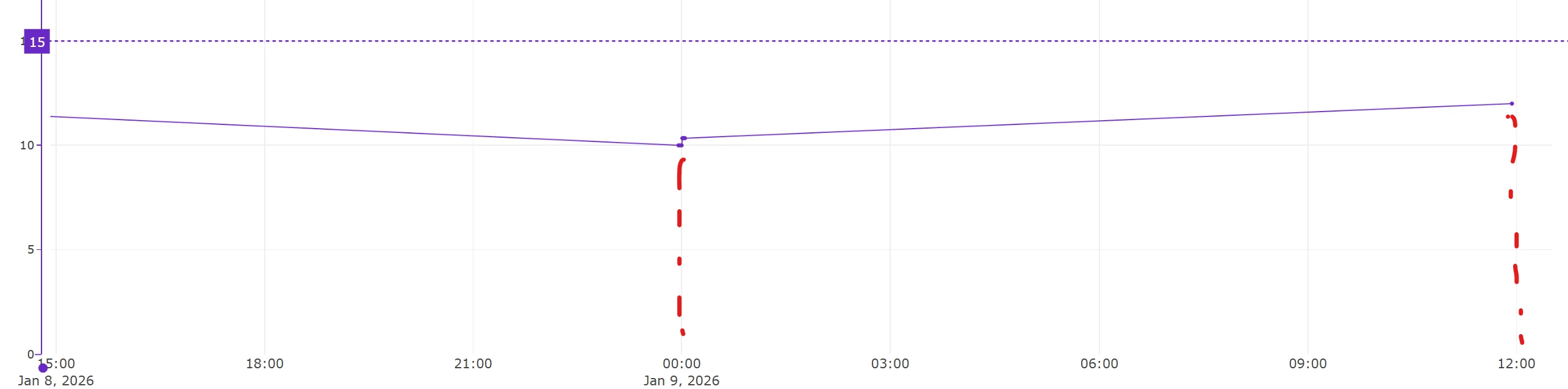
 

Could you consider adding a switch to the Charts monitoring feature that allows users to disable the current specification that excludes data uploaded at intervals longer than one minute from monitoring?

I believe other industries also have data that is captured only once per day.
Allowing users to toggle this behavior as needed would minimize the impact on backend of Cognite Data Fusion.


This request comes directly from field engineers, so I would greatly appreciate your consideration.

2 replies

Shun Takase
MVP ⭐️⭐️⭐️⭐️⭐️
Forum|alt.badge.img
  • MVP ⭐️⭐️⭐️⭐️⭐️
  • January 13, 2026

I was curious about this as well, so I ran some tests.


In my case, I set a threshold for data that updates once every hour.
When the threshold was exceeded, the alert email was indeed triggered.
However, the email was not sent at the exact moment the threshold was crossed—it was sent one hour later, when the next data point was recorded.
Unfortunately, this delay is too long for my use case, so I would also like to request an improvement to the monitoring feature for data that is registered at intervals longer than one minute.


By the way, I have set the monitoring job’s “Minimum duration” to 1 minute, but if anyone has advice on a more appropriate configuration, I would greatly appreciate it.


danielferraz
Expert ⭐️⭐️⭐️⭐️
  • Expert ⭐️⭐️⭐️⭐️
  • June 5, 2026

Hi ​@Daiki Miyazawa , and thanks ​@Shun Takase for the additional testing.

You've described the behaviour accurately. Charts monitoring is currently optimised for time series arriving at roughly 1 minute cadence or faster. The engine evaluates threshold breaches in 5 minute windows and treats each datapoint as representing about 1 minute of duration, so for very scattered data the engine can't reliably distinguish between a healthy sensor that hasn't reported yet and a disconnected one. That's the safeguard you've hit.


We hear the use case. We understand low frequency signals are common in industrial settings, and there are legitimate cases where users have full context on the data cadence and want monitoring to fire on individual datapoints crossing a threshold.


This is on our radar as part of broader monitoring improvements, including configurable execution frequency and sub minute duration support. I can't share a delivery date yet, but I'll update this thread once we have more clarity on timing.


On Shun's point: the email delay is the same root cause. The alert fires at the next evaluation cycle that contains a new datapoint, which is why low cadence data produces visibly delayed notifications.


Thanks for raising this, and please keep the requests coming.


Daniel Ferraz, Product Manager