
 Check the
documentation
Check the
documentation Ask the
Community
Ask the
Community Take a look
at
Academy
Take a look
at
Academy Cognite
Status
Page
Cognite
Status
Page Contact
Cognite Support
Contact
Cognite Support


Summary
Enable aggregation operations (such as step_interpolation) on requests containing both numeric and string time series in the same SDK call.
Currently, aggregation works correctly for numeric time series, but the request fails when a string/alphanumeric time series is included alongside numeric series. This limitation prevents users from retrieving synchronized operational datasets that combine process measurements and categorical/status information in a single query.
Problem Description
When using the Cognite SDK method retrieve_dataframe() with aggregation enabled, requests containing mixed data types fail if at least one time series is of type string.
Example:
- Numeric-only aggregation → works correctly
- Numeric + string aggregation → fails
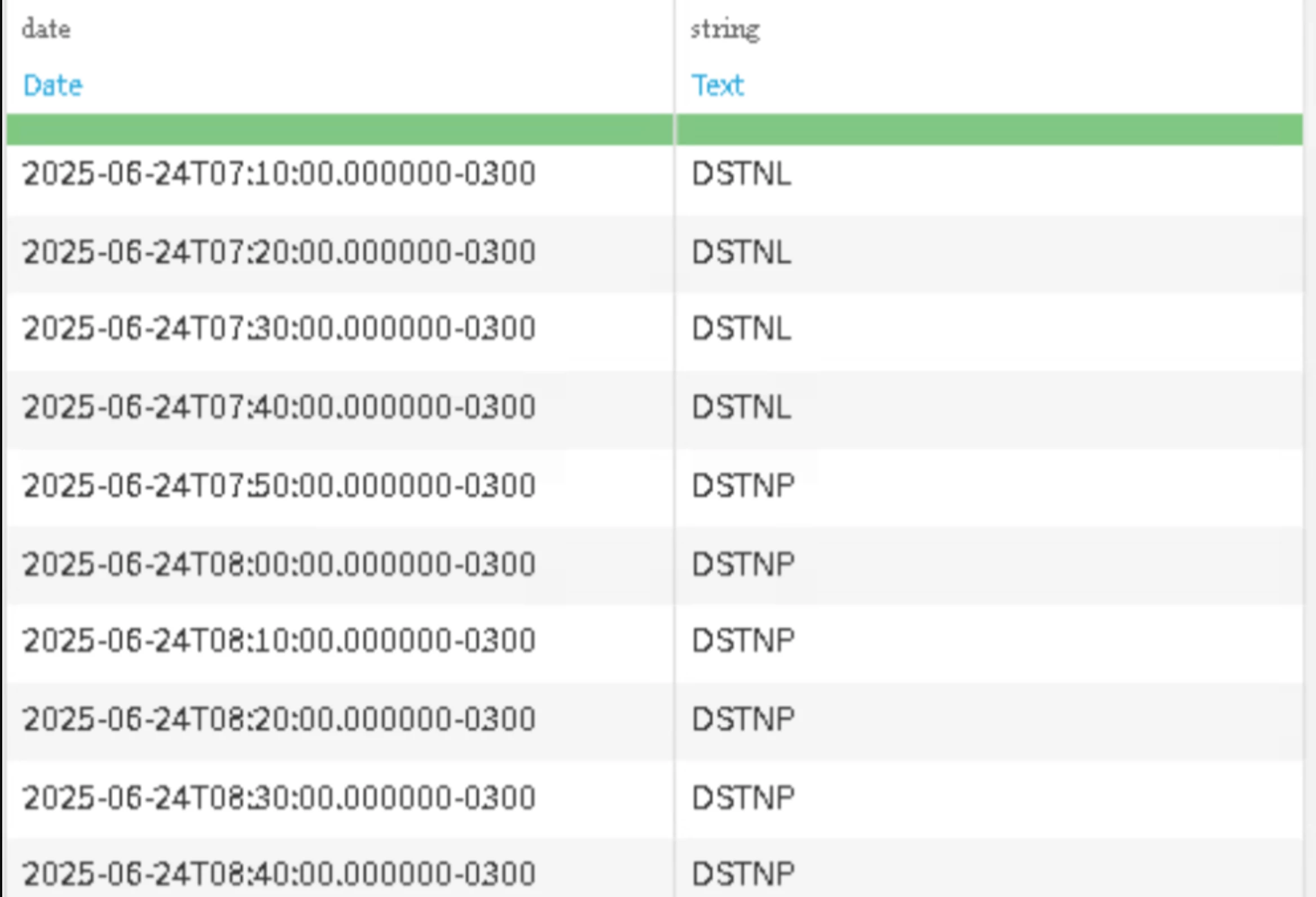
The expected behavior for string time series using step_interpolation is to replicate the last known value across the aggregation interval, similar to how industrial historians such as PI System behave.
Example Use Case
Operational dashboards and analytics workflows frequently require:
- Numeric process variables (temperature, pressure, flow, etc.)
- Text/status variables (campaign, mode, operational state, equipment status)
These datasets must often be retrieved together using the same timestamp alignment and granularity.
Example:
df = client.time_series.data.retrieve_dataframe(
    external_id=[
        "numeric_ts_1",
        "numeric_ts_2",
        "string_ts_status"
    ],
    start="6h-ago",
    end="now",
    aggregates="step_interpolation",
    granularity="1h",
    timezone="UTC-03:00"
)
Currently, including "string_ts_status" causes the aggregation request to fail.
Expected Behavior
For string time series:
step_interpolationshould return the last known value within the aggregation window.- Mixed-type aggregation requests should succeed without breaking the entire query.
- Returned DataFrames should preserve both numeric and textual columns properly aligned by timestamp.
Current Behavior
- Aggregation succeeds for numeric time series only.
- Aggregation fails when a string/alphanumeric time series is included.
- Users must split requests into multiple calls and manually merge results afterward.
Proposed Enhancement
Implement support for:
- Aggregation of string time series using
step_interpolation - Mixed numeric and string aggregation in the same SDK/API request
- Graceful handling of heterogeneous time series types